NEWS
NEWS
Press release
AN ITALIAN ZERO-LOSS SUPERCONDUCTING CABLE FOR THE DATA CENTRES OF THE FUTURE
21/07/2026
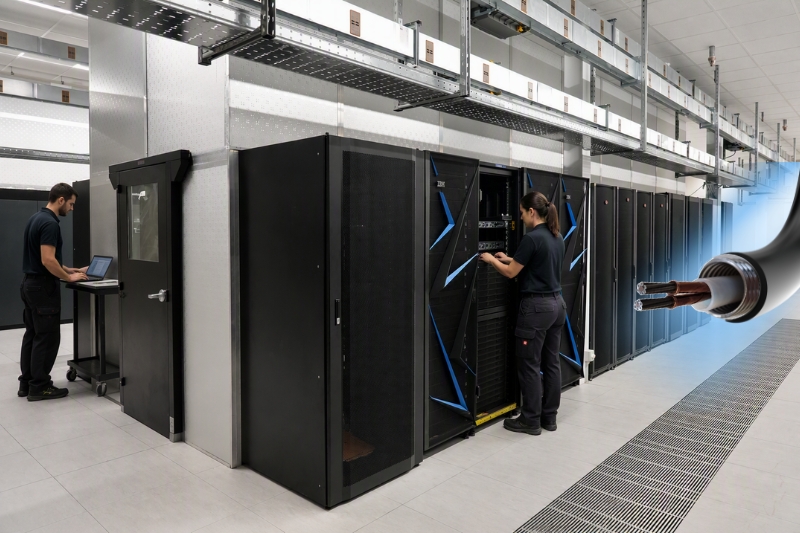
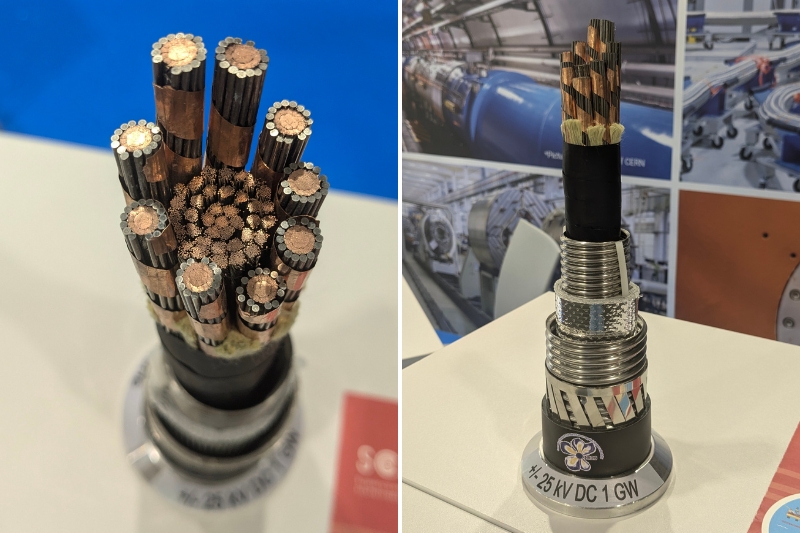
From the synergy between fundamental research and industry comes SURE, a project to develop an Italian technology capable of making the power supply of data centres more efficient and sustainable. Rome, Genoa, July 21, 2026 - Transporting large amounts of electrical energy without losses and with a reduced environmental impact. This is the challenge of the SURE project, which brings together the expertise of the National Institute for Nuclear Physics (INFN) in frontier physics research with particle accelerators and ASG Superconductors’ experience in the design and production of superconducting magnets, cables and systems. The objective is to develop a magnesium diboride (MgB₂) superconducting cable capable of addressing one of the main critical issues of next-generation data centres: combining the growing demand for electrical power required, in particular, by artificial intelligence applications with energy efficiency and environmental sustainability. SURE — acronym for SUperconducting – REliability & Efficiency — stems from an agreement signed by ASG Superconductors and INFN, involved through the INFN-LASA laboratory — Laboratory of Accelerators and Applied Superconductivity — in Milan, which leads the project, and the INFN Frascati National Laboratory (LNF). The project is funded by the Ministry of University and Research (MUR) through the Italian Fund for Applied Sciences (FISA), with total funding of €5.8 million over five years and expected completion in 2031. SURE is a technology transfer initiative that builds on the results of the IRIS project, funded by the MUR with PNRR funds, which is leading to the development of a prototype of a 1GW superconducting cable for the more efficient transmission of large electrical power. “SURE is a virtuous example of technology transfer from research to industry,” emphasizes Antonio Zoccoli, President of the National Institute for Nuclear Physics. “The technologies developed by INFN for frontier physics are now finding a new application in a strategic sector such as data centres, whose energy needs are set to grow with the development of artificial intelligence and high-performance computing. Moreover, they can also be used in many other areas characterized by high energy consumption. Projects such as this demonstrate how research can contribute to creating more efficient and sustainable infrastructures, while at the same time fostering innovation and strengthening the country’s competitiveness.” Davide Malacalza, Chairman of ASG Superconductors, stated: “We have been investing for years in the development of magnesium diboride (MgB₂) superconducting cable technology, a solution that enables significantly larger quantities of energy to be transported in reduced spaces. We are proud that this initiative, intended to support the evolution of data centres, originates in Italy and represents a virtuous example of collaboration between industry and research, thanks to the partnership with INFN, to respond to a strategic challenge of global relevance.” The Technology SURE involves the design, construction and installation of a superconducting cable — functioning as an electrical line — intended to power the new data centre of the INFN Frascati National Laboratory, built thanks to PNRR funding allocated to the National Research Centre in HPC, big data and quantum computing ICSC. At the heart of the line is a magnesium diboride cable, an innovative superconducting material discovered in 2001 and developed by ASG also thanks to the expertise gained within HiLumi-LHC, the upgrade programme of CERN’s Large Hadron Collider. Unlike the superconductors used in large particle accelerators, which require cooling with liquid helium at around 2 kelvin, the cable developed within the SURE project uses magnesium diboride, a material that operates at around 20 kelvin (-253 degrees celsius), reducing the cooling cost by more than ten times. This temperature can be reached through closed-cycle cryogenic systems, already widely used in industrial applications, making the technology easier to integrate and more suitable for continuous use in the energy infrastructures of data centres. “The technology we are developing makes it possible to transport large quantities of energy efficiently and sustainably, integrating naturally with production systems from renewable sources. The objective is to help respond to the growing energy demand of next-generation data centres, reducing their environmental impact,” comments Marco Statera, LASA-INFN researcher and head of the SURE project. Marco Nassi, Chief Executive Officer of ASG Superconductors, added: “The SURE project brings the application of superconducting cables to data centres closer, a sector linked to Artificial Intelligence with exponentially growing demand for electrical energy. This innovation makes it possible to transport up to ten times more energy, with the same dimensions, compared with traditional cable technologies. Moreover, the MgB2 high-temperature superconductor is developed and produced in Italy and does not require the use of rare earths.” Superconducting Cables and Data Centres The SURE project aims to demonstrate, through the pilot site of the INFN Frascati National Laboratory, how superconducting cable technology can represent an effective solution for powering digital infrastructures dedicated to artificial intelligence, including servers, storage systems and high-capacity networks. Superconducting cables operate at cryogenic temperatures. At these temperatures, materials such as magnesium diboride enable the transport of much larger quantities of energy, with the same footprint, compared with conventional cables, eliminating losses due to electrical resistance. Superconductivity in fact allows electric current to pass under conditions of practically zero resistance. MgB₂ technology, developed and produced entirely in Italy by ASG Superconductors, is easily applicable to cables and stands out for the absence of heat dissipation along the cable during operation, together with ease of cabling and electrical connection. This characteristic, together with the availability of industrial cryogenic systems capable of maintaining the operating temperature of around 20 kelvin, makes magnesium diboride a particularly promising solution for next-generation digital infrastructures. Furthermore, the production of this superconductor takes place without the use of rare earths and with a “short supply chain”. Sustainability and Environmental Impact The use of superconducting cables also makes it possible to reduce footprints by up to a factor of ten compared with traditional cables or conventional busways used in data halls. This higher power density makes it possible to optimize spaces and simplify the design of electrical infrastructures. In SURE, the system will also be designed to make available a transport capacity greater than the initial needs of the data centre, making the infrastructure ready for future expansions of computing capacity and related energy requirements. Today, in fact, a significant share of the investments needed to build a data centre must be repeated after only a few years to adapt electrical systems to the rapid growth of computing capacity and related energy requirements. A superconducting power supply network will be able to help reduce these interventions, increasing the flexibility of the infrastructure and improving its long-term sustainability. Furthermore, thanks to the high power density and greater compactness of superconducting cables, new prospects are opening up for the construction and expansion of data centres in densely urbanized areas or areas characterized by infrastructural constraints, where the use of traditional technologies is more complex or not possible. ASG’s Contribution and the Characteristics of the Superconducting Cable Within SURE, ASG Superconductors will play a strategic role by taking care, in collaboration with INFN technical and research staff, of the design, production and installation activities of the prototype cable, which will have the following technical characteristics: length 50 m, power 0.6 MW, superconducting part 1500A at 400V. INFN’s Contribution For INFN, researchers from the LASA laboratory in Milan and the Frascati National Laboratories (LNF) are working on the SURE project. The Laboratory of Accelerators and Applied Superconductivity (LASA) is an infrastructure for the development of frontier technologies in the field of accelerators, magnets and their applications, based in Milan. At LASA, technologies for superconductivity, cryogenics and the production of magnetic fields are designed and developed. The IRIS project was born here, leading to the development of the first prototype of a 1GW superconducting cable. LASA studies the use of superconducting technologies to increase the sustainability of research infrastructures and industrial applications, including superconducting lines for energy transmission. Within SURE, LASA organizes the project, supervises technical choices and measures the properties of the new-generation conductor in its own laboratories. Built in 1955, the Frascati National Laboratories (LNF) were the first Italian research facility for the study of nuclear and subnuclear physics with accelerator machines and are the largest laboratory of the National Institute for Nuclear Physics (INFN). Today, these laboratories are at the forefront in various sectors of physics and its applications. They are the Italian site of EUPRAXIA, a distributed European infrastructure for the development of ultra-compact plasma accelerators for industrial, medical and basic research applications. The LNF are responsible for integrating the superconducting line to ensure its functionality and compatibility with all other scientific activities and supervise the operation of the designed system, obtaining fundamental information on the reliability of superconducting lines connected to the electrical grid, optimizing them for large-scale use. INFN Profile Founded in 1951, the National Institute for Nuclear Physics has been conducting frontier research in fundamental physics for more than seventy years, for which it is now internationally recognized as one of the most prestigious scientific institutions in the field of nuclear, particle and astroparticle physics, both theoretical and experimental, and in the development of technologies for research and their applications for the benefit of society. INFN is a public research body with offices throughout Italy and today has a community of more than eight thousand people working in scientific, technological, technical and administrative fields. ASG Superconductors Profile ASG Superconductors SpA, a company of the Malacalza family based in Genoa and with 200 highly specialized employees, is a leader in the field of superconducting magnets, systems and materials, with more than 75 years of history and experience in significant international projects in the fields of fusion energy, particle physics, magnetic resonance imaging (MRI) and proton therapy. The company has also developed an MgB2 superconducting material and technology which, thanks to simplified cryogenics, enables innovative applications in energy storage and transmission with zero-loss cables.